
100% Free - No Credit Card Required

NBT Preparation
Start For Free.

Prepare for the National Benchmark Test with free MAT and AQL diagnostic quizzes, university degree score requirements, daily practice questions, and a downloadable survival guide - everything you need to ace the NBT.

4.7 (2847 reviews)

Free NBT Tools to Kickstart Your Preparation

Everything you need to understand the National Benchmark Test and start preparing - completely free.

NBT Practice Quizzes

Get a taste of what the NBT is like with interactive sample questions from both MAT and AQL sections.

Sign up free to take the full diagnostic quiz

NBT Score Requirements

Explore UCT faculties and degrees to see the exact NBT score requirements for your dream qualification.

AQL Minimum
MAT Minimum
Faculty Points

Select a faculty to get started

Select a degree to see requirements

Sign up free to see all 58 degree requirements

NBT Tips & Strategies

Essential tips and study strategies from experienced tutors to help you perform your best on test day.

Sign up free to unlock all NBT preparation tips

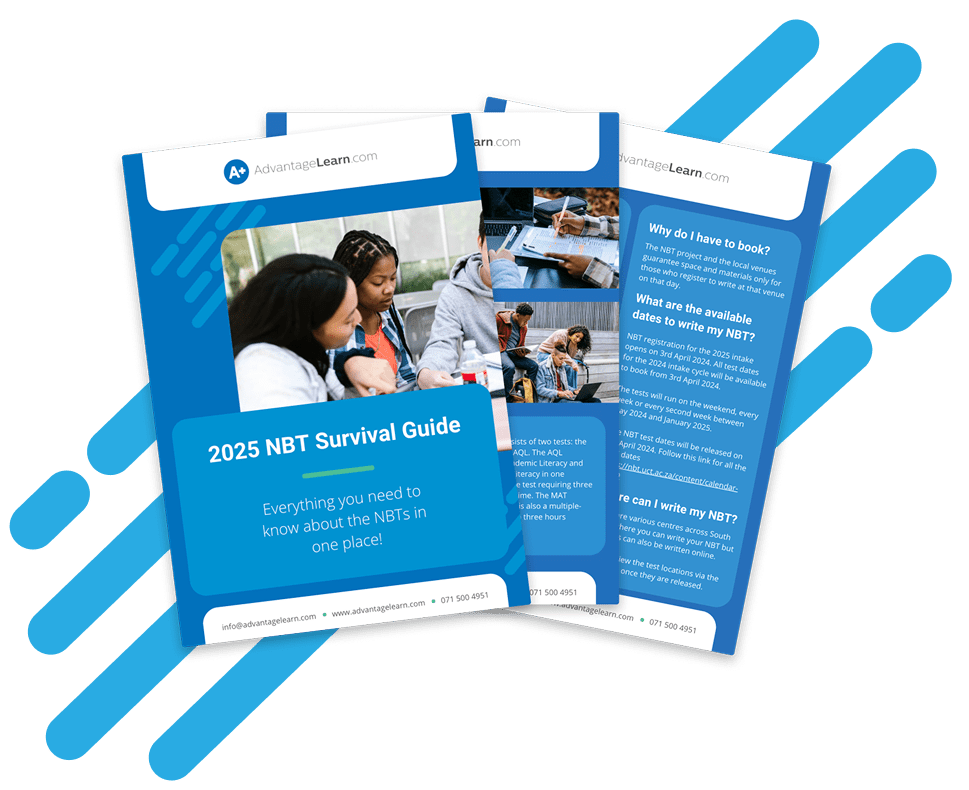
NBT Survival Guide

Everything you need to know about the NBT in one place - from registration and test-day tips to score interpretation.

Free NBT Survival Guide PDF covering registration, test-day tips, and score interpretation

Sign up free to download the full survival guide

Daily NBT Practice

Practice makes perfect. Get a new NBT-style question daily - covering MAT, AL, and QL topics.

Today's Question QL

If the ratio of boys to girls in a class is 3:5 and there are 24 students, how many are girls?

The ratio is 3:5, so there are 8 parts total. Each part = 24 ÷ 8 = 3 students. Girls = 5 × 3 = 15.

Sign up free to get daily practice questions

Frequently Asked Questions About the NBT

Common questions about the National Benchmark Test, answered by our expert tutors.

No FAQs match your search.

Try different keywords or .

📝 How to Register for the NBTs (2025)

Why do I have to register? The NBT project and the local venues guarantee space and materials ONLY for students who have registered to write at a specific venue or online on a specific day.

You need to check the following before you book for the NBT:
  • Your school’s calendar for sporting and social events, holidays and exams
  • Closing dates and application deadlines at all institutions where you intend to apply
  • The language of instruction where you are applying
All this needs to be taken into consideration when you are deciding when the best time is to write your NBTs. Registration for the NBTs is done online and takes about 5 minutes. NBT registration 2026 intake opened on the 1st of April 2025. Follow this link to book your test. Note: you will need your official South African ID or foreign passport in order to complete the registration process. To register you need to go to the NBT website. Watch the video below for a helpful walk-through.


In 2025, the fees are:

  • R185 for AQL only
  • R370 for AQL + MAT
 
📝 What are the 2025 NBT test dates?

Tests run from 18 May to 5 October 2025. When you register, you'll choose one test session (online or in-person) that suits you best. You only need to write the NBTs once — so plan it carefully!

🤔 What is the NBT test?

The NBT test is a set of tests used to assess a learner’s academic literacy, general knowledge, and mathematical skill in an effort to measure academic readiness for university.

NBT stands for National Benchmark Test. This is an examination set up by the National Benchmark Test Project. The NBT is a set of tests used to assess a learner’s academic literacy, general knowledge, and mathematical skill in an effort to measure academic readiness for university. The NBT tests were implemented in 2008 and are managed by the Alternative Admissions Research Project at the University of Cape Town. NBT results are used by many universities as an extra admission criterion for applicants to their institutions. They serve to complement and support, rather than replace or duplicate NSC results.
The NBT consists of two tests: the MAT and the AQL.
  1. The AQL (Academic Quantitative Literacy) is one multiple-choice test of three hours of writing time.
  2. The MAT (Core Maths) is also a multiple-choice test with three hours of writing time. Both papers are written on the same day.
The NBTs are available in English and Afrikaans. When you register you will be asked to indicate the language in which you wish to write.
Note that you can only use one language i.e there is no option to write one test in English and the other in Afrikaans. Dr Abbey Mathekga, the head of the higher education enrolment programme, said: “They [the NBTs] are intended to identify learners who might have problems in certain subjects. They are also aimed at determining the level of competency of learners in certain learning areas.”
⌛ When should I write my NBT?

It depends on the university you're applying to. Some universities want NBT scores by specific dates, often linked to early application deadlines. Here’s what we recommend:

  1. Check your university deadlines first.

  2. Count back 4 weeks (to allow time for results to be released).

  3. Book your test at least 4 weeks before your earliest deadline.

NBT results are valid for two intake years. This means that it is worthwhile writing your NBT in your Matric year even if you are having a gap year. Your syllabus will never be fresher in your mind as it is now. If you cannot write the NBTs in the year before your studies (if, for example, you are overseas), you are allowed to write them in January before the start of the academic year. Bear in mind, however, that you do expose yourself to special risks and practical implications in terms of placement and selection if you write the tests at such a late stage. It is therefore strongly recommended that you write the NBTs in your Matric year.
🤷 What are the NBT tests like?

The National Benchmark Tests (NBTs) consist of two sections: AQL (Academic and Quantitative Literacy) and MAT (Mathematics). Both are multiple-choice tests, each lasting 3 hours.

  • AQL Test: Divided into two parts—Academic Literacy and Quantitative Literacy. Each part lasts 25 minutes, and you cannot skip or return to previous questions once the section ends.

  • MAT Test: The Mathematics section has no time divisions, allowing you to complete it within the full 3-hour duration. It covers areas like algebra, functions, trigonometry, and calculus.

✏️ What to bring to the NBT test?
Before heading to your NBT test, make sure you bring the following essential items:
  1. Identification: Your South African ID book, passport, or a certified receipt of application for an ID.
  2. Registration Documents: Your registration letter and proof of payment. You will need to show this to the venue administrator. They will stamp the receipt and return it to you.
  3. Stationery: Two HB pencils, an eraser, and a pencil sharpener.
  4. Food and Drink: If you're writing both tests, bring lunch and water to keep yourself refreshed.
What Not to Bring:
  • Calculators
  • Rulers
  • Dictionaries
  • Scrap paper, notebooks, iPads, tablets, or phones
Important Note: Learners without an official ID will not be allowed to write the NBTs, except in cases where the following documentation is provided:
  • Birth certificate with an affidavit from the police (including a recent photograph)
  • A letter of application for an ID from Home Affairs.
Be sure to check your registration details and bring everything you need!
💯 How do I get my NBT test results?

To access your NBT results you need to login to your profile on your NBT page. NBT results are only available four weeks after you have written your test.  

Click here to go to the NBT results request page.  
  • Do I have to send my results to the universities I am applying to? The universities request your results from the NBT you do not send them to the university. The NBT charges the University to release the results to them and the 1 test will apply to all universities that require it.
  • Didn't get the results that you wanted? We offer a few online courses that will help increase your results. Our NBT Preparation Online Course will help you improve your MAT and AQL results.
🏢 Which institutions will use my NBT results and how do they get them?
Which institutions will use my NBT results and how do they get them? All the universities to which you apply can receive your NBT results. Many South African universities use the NBTs in conjunction with the National Senior Certificate (NSC) for access to their programmes. The NBTs help to interpret your NSC results and can be used by universities in different ways.
  • Some use them to help make decisions about your access/application to university. This means that your NBT results, in combination with your matric results, are used to determine whether you are ready for academic study.
  • Some universities use the results for placement within the institution. This means that your NBT results are used to decide whether you will need extra academic support after you have been accepted to university.
  • Some institutions use them to develop curricula within their university.
When you apply to an institution, they will place your name on their applicant list. As applications are processed, they send the NBT Project a request for scores that match the applicants on the list. Universities will only get your results when they request them. Before you submit your registration to write the NBT, you are asked to check a box giving permission for your results to be sent to the requesting institutions and for your results to be used in research projects. Be sure to read this and check this box before hitting “submit”. Remember, it is your responsibility to check whether your NBT results have been loaded with your tertiary institution.
❓ Can I write the NBTs more than once?
Some universities do allow their applicants to write the NBT more than once in an attempt to achieve a better result the second time around. However you need to check with the specific faculty and tertiary institution that you are applying to, to make sure that this is the case as not every university will accept the second result. Note If you do choose to write a second time, you should give yourself at least 6 weeks between writing sessions. If you write the MAT test a second time, you must also write the AQL test a second time on the same morning.
💡 NBT Resources
National Benchmark Test Project Additional NBT resources

University info

⚠️ NBT Information disclaimer
These National Benchmark Test knowledge base articles are provided for general information purposes only. While every effort has been used to ensure the accuracy and integrity of these articles using multiple online sources as well as our own information gained from experience, the use of any part of these articles are at your own risk. The provision of these articles does not constitute legal advice or opinions of any kind, or any advertising or solicitation. No lawyer-client, advisory, fiduciary or other relationship is created between Advantage Learning Technologies (Pty) Ltd and any person accessing or otherwise using these articles. Advantage Learning Technologies (Pty) Ltd and its affiliates (and any of their respective directors, officers, agents, contractors, interns, suppliers and employees) will not be liable for any damages, losses or causes of action of any nature arising from the use of these articles or the provision of these articles. These articles are the property of Advantage Learning Technologies (Pty) Ltd. Advantage Learning Technologies (Pty) Ltd in no way presents this on behalf of the official National Benchmark Tests Project and is not affiliated in any way whatsoever. © Advantage Learning Technologies (Pty) Ltd
🙋‍♀️ How is the style of the NBT assessment different to assessment styles learners are used to?
Unlike the US and the UK and many other countries that model their education system around standardised assessments (eg. SATs, ACTs etc) our South African school system more commonly uses summative, continuous and formative styles of assessment (for an explanation of these styles read more here). The NBTs are a standardised assessment and thus this form of assessment is not common for many  South African learners. So how does this form of standardised assessment differ from the usual forms of assessment employed? Here are some examples:  
  • They are multiple-choice based. This is unfamiliar answering territory for many learners and so needs practice before-hand in order to build confidence.
  • The questions are formed around right AND wrong answers and not just the correct answers like we are used to. In other words, you will be faced with a situation where you think to yourself, but BOTH A AND B could be right. This can be really scary. At a high school level, we are groomed to try to get the CORRECT answer hence questions are formed to lead learners to the correct answer.
  • There are no marks for working and hence the questions are formed to test absolute accuracy. This makes it critical to work efficiently and accurately!
  • The order of difficulty does not build through the assessment. The hardest question might be the first question and this often throws learners off from the get-go.
  • A one-time assessment! Most learners write this assessment once and the results are used for university applications. At school, we are used to building our results through many different methods.eg. continuous assessment, outcomes-based projects and portfolios of evidence etc.
  • You can’t use a calculator
  • You don’t know ahead of time what is going to be tested - in school you know at least what part of the syllabus is going to be tested.
We could go on for ages but I think you get the message, it is very different to what you are used to!
📆 What to expect on the NBT test day?
Writers are reminded that the test is undertaken in a secure proctored online environment. You will be monitored throughout the test to ensure that you follow all testing procedures. Your entire test session will be recorded. You may only have a piece of paper and a pen/pencil in the test room. Books, cell phones, smartwatches, calculators, and any other items are strictly prohibited. Please ensure that you comply with all test requirements to avoid the invalidation of your test. Instructions will be provided on screen.
  • Online Test sessions start times will be communicated to you for each session. For most test dates the morning sessions start at 09h00 and afternoon sessions start at 14h00. Please login 30 minutes prior to the start time to allow for the Lockdown Browser Download.
  • Each test has a duration of 3 hours. Please ensure that laptops, computers, routers, mobile hotspots etc. remain connected to mains power/chargers to avoid battery failure during the tests. Should your device shut down you will be exited from the session.
  • You will require approximately 500mb to complete each test including the Lockdown Browser download. Please ensure that you have sufficient data available.
  • You should take your test in a quiet room with a blank wall behind you, with good lighting.
  • The Laptop or Computer camera must be operational and facing your face at all times during the test, otherwise, your session may be invalidated. There is a photo panel visible to you during your test so that you can check your camera is functional and your face visible.
  • Your face must be visible so no hoodies or clothing that completely obscures the face are allowed.
  • You may not wear headphones during the test session.
  • Any other person entering the room, or movement in the room will be picked up by the camera and will invalidate your test session.
  • You may only have a piece of paper and pen/pencil in the test room. Books, cell phones, smartwatches, calculators and any other items are strictly prohibited. These items will be picked up by the system and will invalidate your test session.
  • Bathroom breaks are permitted but must be less than 5 minutes in duration. Please ensure that you do not exit the test or the lockdown browser and ensure that your laptop or computer does not enter “sleep” or “screen/power saver” mode while you are away as this may affect your session.
  • You may have a bottle of water (or another liquid refreshment) with you during the test.
⏰ How long are the NBT tests?

Writers must login to the test site by 14h30. Writers that did not login to the test simulation (required) will be required to capture a Photograph and download the Lockdown Browser.

The AQL is written in the morning (3 hours writing time). The MAT is written in the afternoon on the same day, with a short lunch break between the two tests. The MAT also has 3 hours of writing time. No learner is allowed to start at midday to write just the MAT test. If you are writing the MAT test, you must write it on the same day as you write the AQL test.
📊 What NBT results do I need
Degree Recommended Test Date MAT or AQL NBT result to aim for
MAT AL QL
Medicine Before 1st July Both 90% 70% 80%
Engineering & Built Environment Before 1st July Both 80% 65% 80%
Business Science Before August Both 75% 65% 60%
BCom Before August Both 60% 60% 50%
Health Science Before August Both 70% 70% 70%
BSc Before Trial exams Both 65% 65% 60%
BA Law Before Trial exams AQL - 60% 50%
*Each institution determines which tests are required i.e the university and faculty where you apply will determine which tests you must write (AQL or MAT, or both). Please check with each institution/faculty where you intend to apply, before you register for the NBTs with regards to their application requirements including closing dates and deadlines for receiving NBT results. Please note that each university has different requirements and each faculty may require different tests or have different deadlines.
🧪 Which NBT tests do I need to write?

There are two NBTs:

  • AQL (Academic Literacy & Quantitative Literacy) – required by all universities that require the National Benchmark Tests.
  • MAT (Mathematics) – required only if the course you’re applying to needs Maths (e.g. Engineering, Medicine, Commerce, etc.).

Not sure if you need MAT? Check the requirements on your university’s website or ask their admissions team. Alternatively download our NBT university requirements guide to learn more!

📑 What is the difference between AQL and MAT?

The NBT test assesses readiness for tertiary study. It is made up of two assessments: AQL and MAT.

  • The AQL (compulsory for all learners who are required to write the NBT) aims to test proficiency in language comprehension as well as logic-based numerical skills. It assesses knowledge learned in the senior high school phase. It aims to assess whether learners will be able to apply knowledge learnt in high school to the tertiary context. The AQL section comprises approximately 75 multiple-choice questions.
    1. The Academic Literacy (AL) sections will require reading of various texts with multiple choice questions referring to the text. Some questions are general knowledge-based. Questions on grammar, punctuation, vocabulary are included. It predominantly assesses the ability to understand the meaning and application of various texts as well as understanding and applying the argument or main point of the author.
    2. The Quantitative Literacy (QL) sections assess a student’s capacity to: understand basic numerical concepts, read and interpret graphs, reason logically and identify patterns and trends. It is largely based on the Grade 11 Maths Literacy syllabus.
  • The MAT paper is a separate three hour paper (only written by learners applying for certain degree programmes and who have done Core Maths at school) and assesses mostly Grade 11 Core Maths syllabus content although some Grade 12 work is included, depending on the time of year the assessment is written. It also takes a multiple-choice format. It tests proficiency in such areas as problem solving and modeling, functions, trigonometry, spatial perception, and probability.
Both the AQL and MAT are differentiated into cognitive levels, meaning there is a range in difficulty in each section – with the easier applications generally coming first.
🗓️ When should I prepare for the NBTs?
It is important to attend an NBT workshop in your Grade 12 year. It does not matter when you attend an NBT workshop. The important thing is to make sure you utilise the online course in the 2 weeks leading up to the NBTs to make sure the content is fresh for when you write the test. If you are a post Matric learner needing to sit the NBT then we highly recommend you re-study your Grade 11 Mathematics before attending a workshop. You can do so through our Maths Online Grade 11 Path. To view our NBT Preparation courses click here.

Start Your Free NBT Preparation Today

Join 35,000+ students who have discovered their National Benchmark Test readiness with free MAT and AQL practice tests and are now confidently preparing for their future.

Advantage Learn is a registered Distance Education Provider with

IEB logo SACAI logo
Want news, promos and updates?
Sign up for our newsletter.
American Express Visa Mastercard Ozow Zapper EFT Payments
SSH shield

This site is secured with 256 bit SSL encryption

© Copyright 2026 Advantage Learning Technologies (Pty) Ltd. All rights reserved. Use of this website is regulated by our website Terms of Use, Terms and our Privacy Policy.